Underneath Frustration is a card engine that doesn't care what game it's running. It
deals, it holds the rules, it keeps turn order, it seats people who are in the same room
and people who are three states away at the same table, and it makes eleven cards
legible on a phone. Every game we add is that same table wearing something different.
Pass one device round the table, or everyone on their own with a five-character
join code. The engine doesn't care which, and a table can be both.
Get up mid-game. Your seat plays itself until you're back — politely, and
badly. At fifteen seconds a loon dives; at zero it takes your turn for you.
A game is a rule set, and a rule is data. House rules are a setting you pick
before the deal, not a different app.
An evening is booked as a game, then a format — the whole ladder, one
quick hand, something you built — so the second game fits the day it exists.
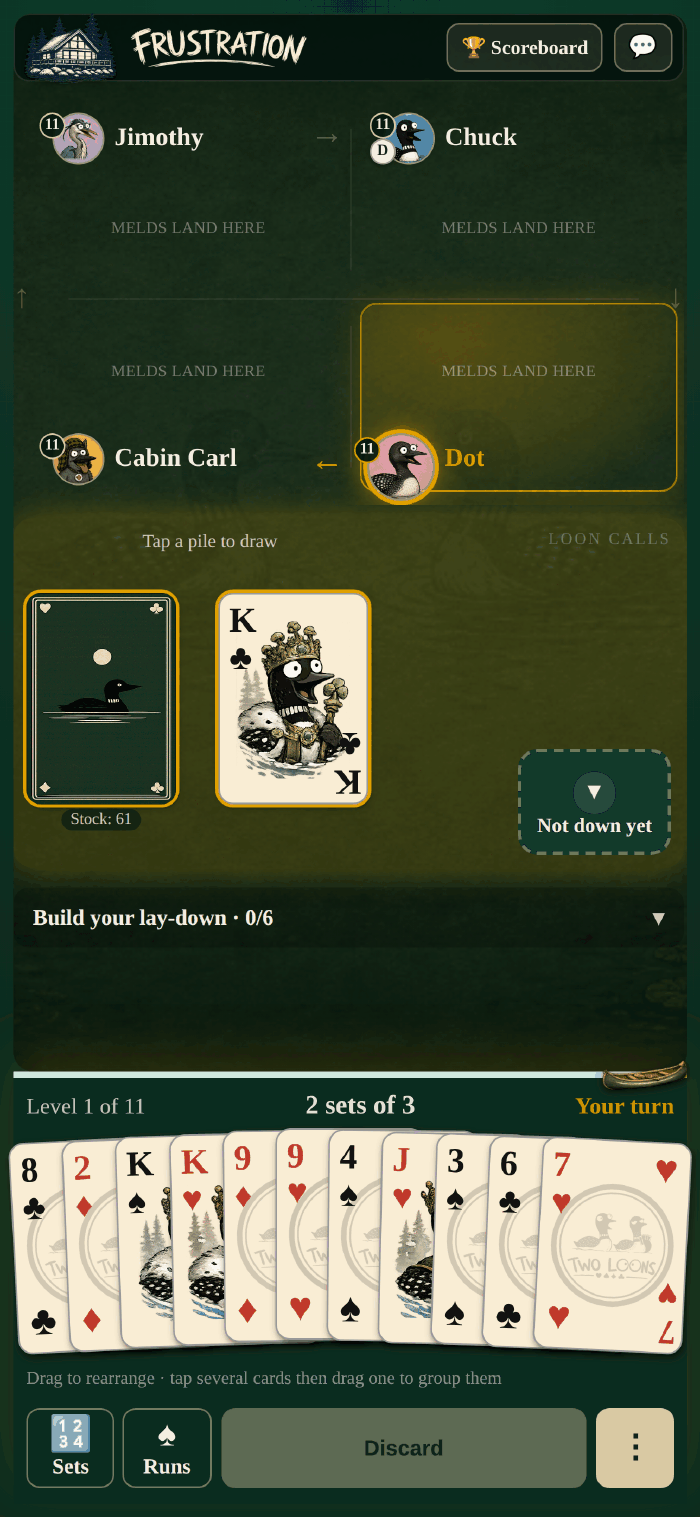
The table, wearing Frustration. Four seats, everyone's melds in their own
quarter, eleven cards you can read.
What the table does so the game doesn't have to
A card game on a phone is mostly not the card game. It's the seating, the turn, the deal,
the part where somebody's kid needs putting to bed, and the part where eleven cards have
to fit in a thumb's reach. That's the engine, and it's the same for every game.
Nobody shuffles
A cupboard of ten decks, each a back and its two jokers, and the dealer grabs a
fresh handful every hand. No bent corners, no missing joker.
Nobody waits
Step away and the table keeps its shape. Your seat covers for you, the clock keeps
everyone honest, and the game is there when you're back.
Nobody's crammed in
Same room, better chairs — or different rooms entirely. A seat is a seat whether the
phone is being passed or is in somebody else's house.
Nobody ends it early
Somebody leaving at nine doesn't kill the game, and neither does starting one that
takes three evenings to finish. The table remembers where you were.
You still have to argue about the rules. That part we would never automate.
The games
One is live. The rest are in the order the die-hards asked for them, and none of them
starts until the one underneath actually works.
Eleven levels, eleven cards a hand, only 2s are wild. Rummy with house rules mean
enough to stay interesting. Free while it's in beta, and bugs come first: everything
below this line waits on it, on purpose.
Next
Rummy and crazy eights
The two for the long-standing-rules crowd, and the two the table already knows most
of how to run — melds, runs, a draw pile and a discard pile are Frustration's own
furniture.
Then
Cribbage, euchre, hearts, spades, pitch
Tricks and partners, which the table hasn't dealt yet. Each with its own face, all on
the same felt, all with a seat that covers for you while you get the door.
Frustration's six shapes of game, as the catalogue offers them
The whole ladder All eleven levels, in order. The proper game.
One quick hand A single level. Ten minutes, tops.
Three at random Three levels, drawn when you set it up.
The deep end The hard half of the ladder. No warm-up.
Time 4-4 Four levels on a short clock.
Speed dating Two players, ninety seconds a turn.
And a seventh, something you build — pick the levels, the clock and the rest
yourself. A format is what an evening gets booked as, which is why a game has formats
rather than a settings screen.
Started
Your family's rules
Every family plays it wrong, and differently. That isn't a problem to fix; it's the
thing the engine is built around.
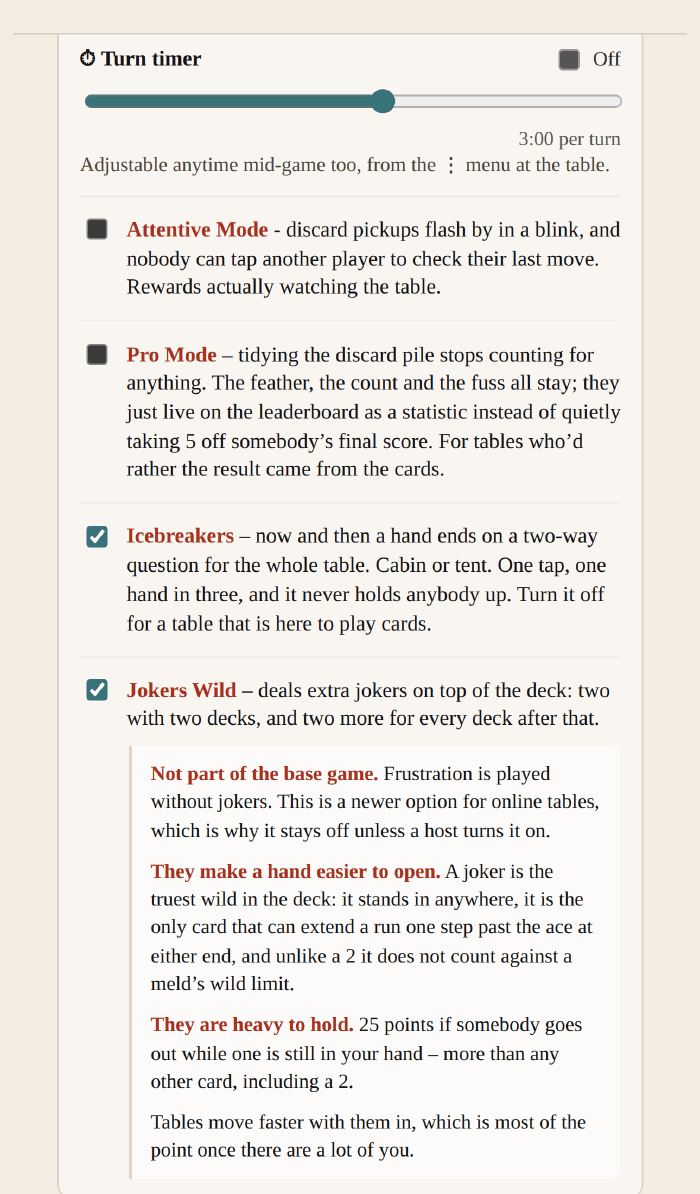
A preset fills the level list in and then gets out of the way. Untick the levels you
haven't got time for, reorder the rest, and the match plays whatever's left. Set the
clock, or switch it off. Turn on Jokers Wild, Attentive Mode, Pro Mode — every switch
explains what it changes before you flip it.
The engine already treats a rule as data rather than as code. The work left is how
much of it we're brave enough to expose, and in what order, so that a house rule stays
a house rule and never becomes a second game nobody can find the settings for.
House rules, as switches. Every one of them explains itself.
Someday
You build it, we run it, we split it.
Open the engine up. You bring a game, a rule set and a theme; the table handles dealing,
turns, layout, payments and the part where it has to be fun on a phone. What it makes, we
share.
Not live, and we're not going to pretend otherwise. No ads, no money, no open engine
until the game works. This is a lake, not a roadmap conference.